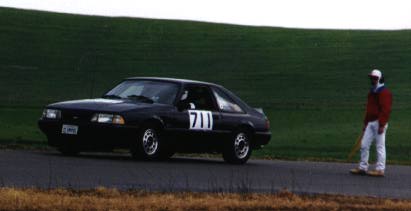
Fiancee Ruth Colby drives Beastie at Thunderhill Park, Willows, CA. Photo by Walt Bruegger
Here's what's on Beastie, my '89 Mustang LX 5.0 Sport, at the moment, subject to change without notice! You can see in the photo below that the car is mostly stock appearing from the outside, if a little lower than stock.
Fiancee Ruth Colby drives Beastie at Thunderhill Park, Willows, CA.
Photo by Walt Bruegger
Until it spun a rod bearing at Thunderhill Park due to oil starvation from cornering forces, the motor was essentially stock, the exceptions being a K&N air filter, a 3-row radiator, an oil cooler, Jacobs ignition wires, and .080" plug gaps. The original motor went 126K miles with little more than ordinary preventive maintenance. It dyno'd at 203 BHP at the rear wheels just prior to its demise -- not bad at all compared to the factory rating of 225 HP at the crank, and a testament to the benefits of Mobil 1 synthetic oil. The original clutch and linkage lasted just as long as the motor, and indeed the clutch disc still had lots of material when it was removed.
The new motor is basically the same configuration, with some minor performance upgrades. First on the list are the oiling and cooling system changes: TRW high-volume oil pump, Serck/Mocal oil cooler, Canton road race oil pan, and Flow Kooler high-volume water pump. The intake system consists of a 77 mm MAF, 65 mm throttle body and EGR spacer (all from Ford Motorsport), and Extrude Hone ported intake manifold. From there the mixture flows through ported heads with 1.7:1 Crane "Cobra" roller rockers and upgraded valve springs. Mac 1-5/8" shorty headers exhale the fumes into an otherwise stock exhaust system. ARP rod and head bolts hold it all together. The Jacobs plug wires have been replaced with a Ford Motorsport set, and the stock plugs are now gapped at the stock .054" spec. Once again Mobil 1 15W-50 is the lubricant of choice on the street, Amsoil 20W-50 at the track. Coolant is distilled water, with Red Line Water Wetter and soluble oil only, and passes through a 195 degree Stant Superstat. The worn-out stock fan clutch has been replaced with a Hayden heavy-duty model. A Ford Motorsport clutch feeds the power to the rest of the drivetrain.
The motor was installed in late June of '94, and dyno'd in January '95 at 219 BHP @ 5000 RPM on the same dyno as the previous test. On the street, it's as docile as a stock motor, but it pulls hard to the 5800 RPM redline on the (slightly optimistic) stock tach! Oil temps stay under 240 degrees F and coolant temps are very stable in track use.
Update: I've since installed a Crane 2040 cam (same as the Ford Motorsport -E303 cam) and Crane's bolt-down 1.6:1 rockers into this engine. The results were less than ideal. This cam is great from 4000 RPM up, but with the 1-5/8" headers, low RPM driveability is less than ideal, and gas mileage is down. Things improved quite a bit when I swapped in some JBA 1-1/2" headers and a Bassani X-pipe with catalysts. The X-pipe helped a bit with the midrange and top end; the smaller headers improved low RPM torque substantially. Driveability is much better now, but I still can't recommend this cam for use in traffic.
Cooling system update: In summer 2001, I replaced the radiator with a Griffin 2-row aluminum radiator, which incorporates an oil cooler in the cold tank. An Edelbrock pump motivates the coolant now. The oil system is much simplified, since the cooler in the radiator doesn't require an oil thermostat, and I gained a good 5 PSI in oil pressure!
Gathering dust in the garage is my next engine... a stroker using the original engine block from this car. Watch this space.
Next in line is a stock T5 transmission, the last original component in the drivetrain. U-joints were upgraded to Dana heavy duty units in March '94. The rear end has been upgraded to 3.55:1 gears, and the Traction-Lok is shimmed to within an inch of its life. The axle shafts have been replaced with Moser OEM equivalents. I'm currently using Mobil 1 ATF in the trans, and Amsoil 80W-90 gear lube in the diff. Amsoil, Mobil 1, and Red Line lubricants have been used more-or-less interchangeably, with no discernable differences in performance or shift quality.
Update: The stock T5 finally wore out, oiling the clutch in the process, and was replaced in 1999 with a Ford Motorsport T5Z. But the Le Mans 5th gear got to me after a while, so I had Bruce Couture swap in an 0.73:1 5th in the summer of 2001 - much nicer! At the same time, the clutch was replaced (again!) with a Ford Racing King Cobra unit, and the clutch linkage uses a Forte's adjustable cable kit (which I highly recommend).
Maier Racing subframe connectors and strut tower brace were installed in late 1991. The subframe connectors are overkill, and sacrifice some ground clearance. I don't care! They are STOUT. The strut tower brace was modified in Dec. '94 by replacing the cross bar with a differently shaped bar; the original cross bar interfered with the #1 plug wire and failed to clear the oil filler cap. A used bolt-in roll cage was installed in March of '95 for open track use.
The front suspension is the most heavily modified area of the car, and there's more to come. I've installed urethane bushings in the strut mounts, sway bar pivots and end links. The sway bar pivots need frequent lubrication; you can't just install 'em and forget about them. I've installed grease fittings but am not sure if they are doing the job. The front control arms have been replaced with Ford Motorsports arms (reputedly identical to OEM). Springs are Eibach competition, dropping the car about 1-1/2", and the lower holes on the Koni red struts have been slotted 1/16" in the search for extra negative camber. A Central Coast Mustang camber/caster kit adds much-needed caster and not-so-necessary camber; with the slotted struts, I can now run as much as 3 1/2 degrees negative camber! The CCM bump steer kit is also installed; the offset bushings for the steering rack need to be pinned down somehow, or the rack will move around under load. There will be more modifications in this area in the near future.
Rear control arms are all police/taxi parts, as are the bushings in the rear axle. That's it so far.
Shocks and struts are adjustable red (street) Koni struts up front, with double-adjustable yellow (sport) Konis in back, and red Koni quad shocks. The combination works well, after Koni's tech support guys pointed out I had the rear shocks way too stiff.
Before I went nuts on the front end, street alignment specs were -1.3 degrees camber, 0 toe. This resulted in some minor excess wear on the insides on the street, and lots of outside tread rollover on the track. With the current setup I get no less than -1-3/4 degrees negative camber, so the tires are going to show some inner shoulder wear. Oh well...
Update: The red Konis have been swapped for double-adjustable Koni yellows, a Ford rebuilt steering rack replaced the original when it started bleeding PS fluid everywhere, and the rear lower arms were replaced with a pair of Griggs adjustables. The Griggs arms freed up the rear end... so now I can feel all the monkey motion that's going on back there. I'm saving my pennies for the full Griggs kit.
The front calipers have been replaced with Lincoln LSC calipers, which offer a larger piston but are otherwise identical to stock. Stainless steel sleeves locate the front calipers on the slider pins. The front rotors will soon be upgraded to a separate rotor/hub arrangement, with Coleman directional rotors originally intended for a NASCAR stock car's rear brakes. Timken wheel bearings and Amsoil HD synthetic grease keep everything turning properly. Front pads are Carbon Metallic: their CM80 compound works wonders on the road course, and their HP street compound provides more-than-adequate braking on the street. In an attempt to get more air into the rotors, the splash shields on the front brakes are completely cut away, which may be a mistake. A fabricated air dam incorporating badly needed brake ducts is installed for track use; on the street, a smaller air dam ensures adequate ground clearance, while shunting air out from under the chassis.
The original rear drums have been replaced with discs from Stainless Steel Brakes, with the original pads from the SSB kit. A set of Carbomet Plus pads helps preserve the front/rear balance. The splash shields were not installed, to aid in cooling.
The master cylinder is the SVO piece from the SSB kit. All of the stock rubber hoses have been replaced with Earl's Speed-Flex stainless steel braided Teflon hoses. These hoses require substantial care in installation and frequent inspection; they're not for everyone. The pedal feel improved dramatically though -- it's like stepping on a brick! Brake fluid is Motul 300, and gets flushed and bled before each track date.
Update: No changes here, except that Performance Friction discontinued all pads in the 11" Mustang pattern in 2001. I'll be looking for a new brake pad supplier soon.
Inside, an Autopower roll cage intended for Showroom Stock racing protects the occupants on track dates. I literally threw out the stock seats and installed Recaros. At $1300 the pair, it's the most expensive single modification, but worth every penny. 3" wide racing harnesses clip in for track dates. An Optima battery now occupies the space formerly filled by the right rear seat; 1 gauge welding cable makes sure there's no lack of juice at the starter. The felt pads under the cargo area were removed long ago and save probably 10-15 lbs. with no ill effects, save a slight increase in noise.
On the street, I run 225/60ZR15 Comp T/As. Street tire pressures are 35 front, 31 rear, dead cold first thing in the morning. I've had relatively even tread wear, except for some inside shoulder wear on the front, with these settings. My most recent set of 3rd generation Comps lasted about 31K miles of mostly daily-driver use. Track tires are Bridgestone RE71RAZ, also in the stock size on a spare set of OEM rims. Track tire pressures are of course somewhat higher than the street, but I haven't dialed them in for these tires yet.
Update: Still using Comp T/As on the street, but at slightly lower pressures, as a concession to the rough roads around my home town. I haven't seen the track in a while. One problem is that no one makes road racing radial tires in 15" sizes any more! I may be forced to go to 17" wheels.
The whole combination works extremely well on the street. The ride is a little busy and noisy, and the roll cage gets in the way as you climb through the door. But the handling is worth it! My lap times are nothing to write home about, but I'm working on it. And the car feels secure and responsive on the road. Not bad for an under-experienced driver and overly experienced car!